


By Hiren Gohel, Specialised Hardwares
Kenya’s rules on workplace first aid changed in 2023, under the Occupational Safety and Health (First Aid in the Workplace) Regulations. They set out, in specific numbers, how many trained first aiders a business needs for its headcount, and what has to be in the box itself. Most employers we talk to have never seen the actual thresholds — they know they’re supposed to have “a first aid kit somewhere” and leave it at that. Search interest backs this up: Google search-volume data for “first aid kit” in Kenya averages around 2,900 searches a month and climbs past 5,000 in January to March, a pattern that has held for the last year of data. Whatever is driving the January rise — new-year compliance checks, sites remobilising, insurance renewals — it means most people are shopping for this after the question has already come up, not before.
In short: a single first aid box covers workplaces up to about 10 people; step up to a medium box for 11–20, and a large box (wall-mounted or free-standing) for teams up to 50. For a vehicle, small shop or single office, the compact plastic box is the right size. All five are in stock in Nairobi. None of them come with medicine inside — Kenya’s regulations specifically exclude it — and separately, the law requires you to appoint and certify a set number of first aiders based on your headcount, which a box on the wall doesn’t do on its own.
What the law actually requires
The Occupational Safety and Health (First Aid in the Workplace) Regulations set two separate requirements, and it’s easy to only do the first one.
The first is the box itself: every workplace has to provide and maintain a “readily accessible first aid box or cupboard,” with contents that scale up in bands as headcount grows — the regulations set out what a box should hold for workplaces of 1–9, 10–50, 51–100, and 101–500 workers, covering items like gauze, sterile dressings, bandages, gloves and resuscitation masks. One detail surprises most people: medicine is specifically excluded from the box. A first aid box is for dressing and stabilising an injury, not for dispensing painkillers or anything else.
The second requirement is people, not equipment — appointing enough trained first aiders for the size of your workforce:
- 1–9 workers: at least one appointed first aider
- 10–20 workers: at least two
- 21–50 workers: at least three
- 51–100 workers: at least five
- Over 100 workers: at least five, plus two more for every additional 100 workers or part thereof
Whoever is appointed needs a valid certificate of competence from a training institution approved by the Director, renewed every year — it isn’t a one-off box to tick. Only workplaces with more than 500 workers need a dedicated first aid room staffed by a nurse, clinical officer or medical practitioner; everyone below that just needs the box and the appointed, certified people.
The kits we stock, and who each is for
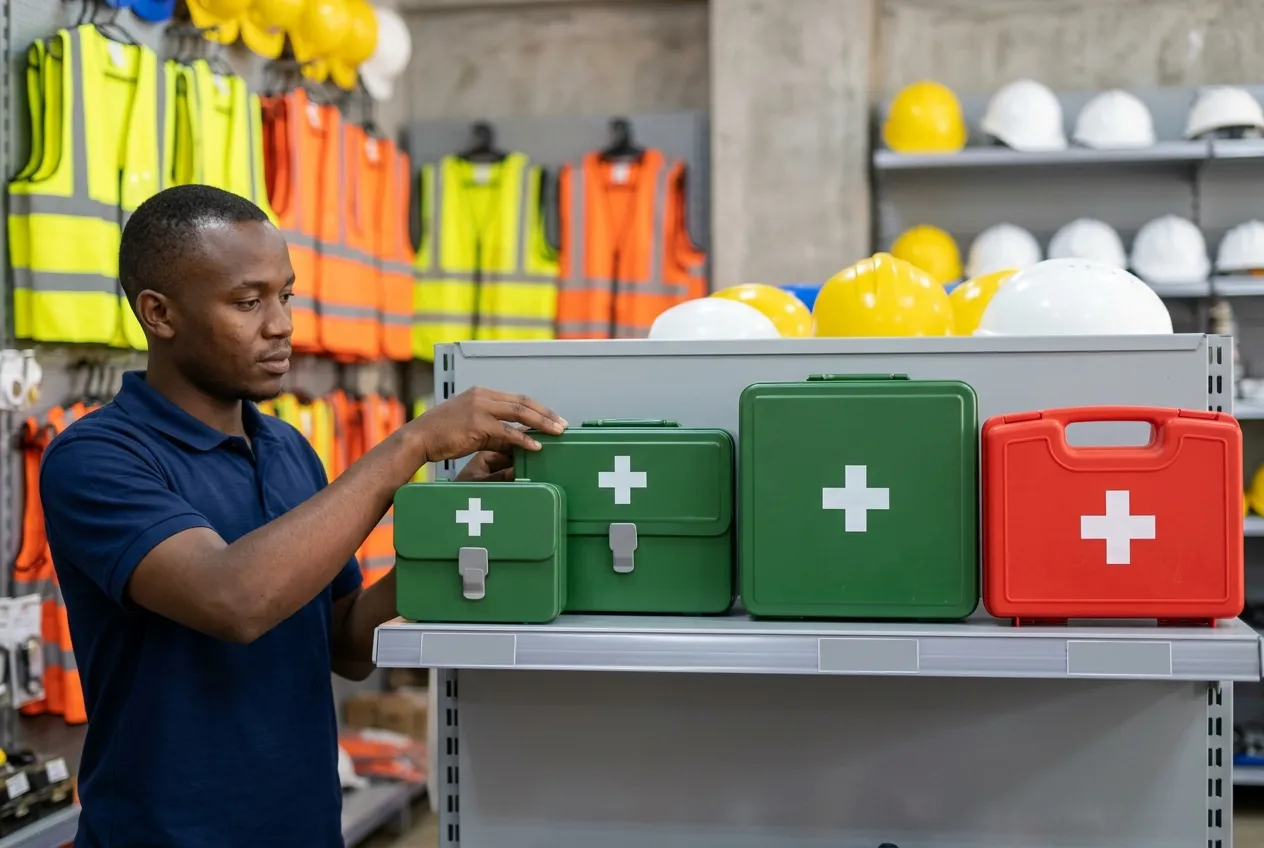
We carry five first aid kits, sized around the same kind of headcount bands the regulations use, so choosing one is mostly a question of how many people are on site.
Metal box, small — up to 10 people
A compact metal box for a small office, workshop or shop floor. The right starting point for any workplace at the lower end of the headcount bands above.
Metal box, medium — up to 20 people
Same format, more capacity, for a mid-sized team where a 10-person box would run short.
Metal box, large — up to 50 people
Free-standing version for larger sites and floors, sized for the top of the “10–50 worker” contents band in the regulations.
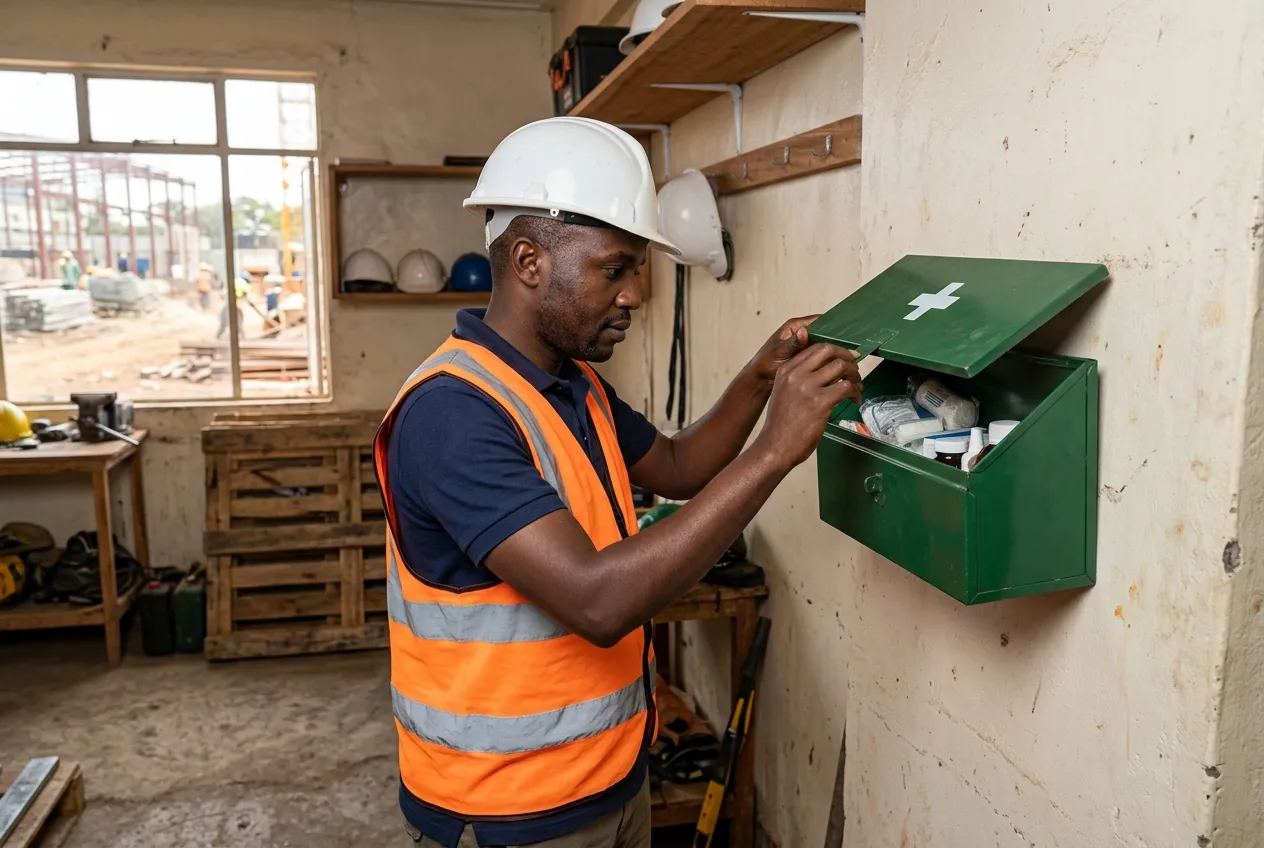
Metal box, large, wall-mounted — up to 50 people
Same capacity as the large box above, but fixed to a wall — the better choice for a factory floor, warehouse or construction site where a loose box tends to wander or get buried under other equipment. Mount it somewhere every shift can reach without needing a key or a supervisor.
Plastic box — vehicle, shop or office
A lighter, portable plastic case for a single vehicle, a small retail unit or a standalone office where a metal wall box isn’t practical. It’s the one to keep in a glovebox or under a counter rather than mounted.
Metal or plastic — which one for which setting
Where the box lives matters as much as its size. A metal box, especially the wall-mounted large one, is built to stay put in one location and take the knocks of a working site — that’s the right choice for a factory, warehouse or construction site where the box needs to survive dust, impacts and being checked daily. The plastic box is about portability rather than durability: it belongs somewhere the “site” moves, like a company vehicle, or somewhere the risk profile is lower, like a small shop counter or a single office where a mounted metal box would be overkill.
Keeping it compliant, not just present
A box on the wall isn’t the same as being compliant. Three things are worth checking on a schedule rather than once: that the box’s contents still match the level the regulations set out for your headcount band (items get used and not replaced); that nobody has quietly started keeping medicine in it, which the regulations don’t allow; and that your appointed first aiders’ certificates haven’t lapsed, since they need renewing every year. We supply the box — the contents schedule and the certification are worth checking directly against the regulations or with a compliance adviser, since the exact list is quite specific and it’s not something we’d want to guess at on your behalf.
Ordering for a site or a whole workforce
We supply all five kits with delivery in Nairobi and countrywide, and can scope a request for quote around your headcount and number of sites rather than a flat price list — useful if you’re fitting out several floors or vehicles at once rather than buying one box.
Frequently asked questions
How many first aiders does a Kenyan workplace need to appoint?
It scales with headcount: at least one for 1–9 workers, two for 10–20, three for 21–50, five for 51–100, and five plus two more for every additional 100 workers after that. Each appointed first aider needs a valid, annually renewed certificate of competence from an approved training institution.
What size first aid kit do I need for my team?
A small metal box covers up to about 10 people, a medium box up to 20, and a large box (wall-mounted or free-standing) up to 50. For a single vehicle, shop or office, the portable plastic box is the better fit than a wall-mounted one.
Can I keep medicine in the first aid box?
No — Kenya’s first aid regulations specifically exclude medicine from the box. It should hold dressings, bandages, gauze, gloves and similar items for stabilising an injury, not tablets, ointments or other medication.
Does a small office need a dedicated first aid room?
No. A dedicated first aid room staffed by a nurse, clinical officer or medical practitioner is only required for workplaces with more than 500 workers. Below that, an accessible box sized to your headcount and the right number of certified first aiders is what the regulations ask for.
Can Specialised Hardwares supply first aid kits in bulk, with delivery?
Yes — we deliver in Nairobi and countrywide, and can put together a request for quote scoped to your headcount and number of sites rather than a flat price list.
First aid is one piece of keeping a site compliant, not the whole picture. We’ve also covered gumboots, hi-vis vests, rainwear and dust masks and respirators in the same buying-guide series, if you’re fitting out a site rather than one box.
Browse the full first aid kit range in stock now, or get in touch for a bulk quote scoped to your headcount and sites.








Recent Comments