


An auto-darkening welding helmet costs more than a standard flip-front one. The question worth answering before paying the difference is what that extra cost actually buys — and whether it matters for the welding you’re doing.
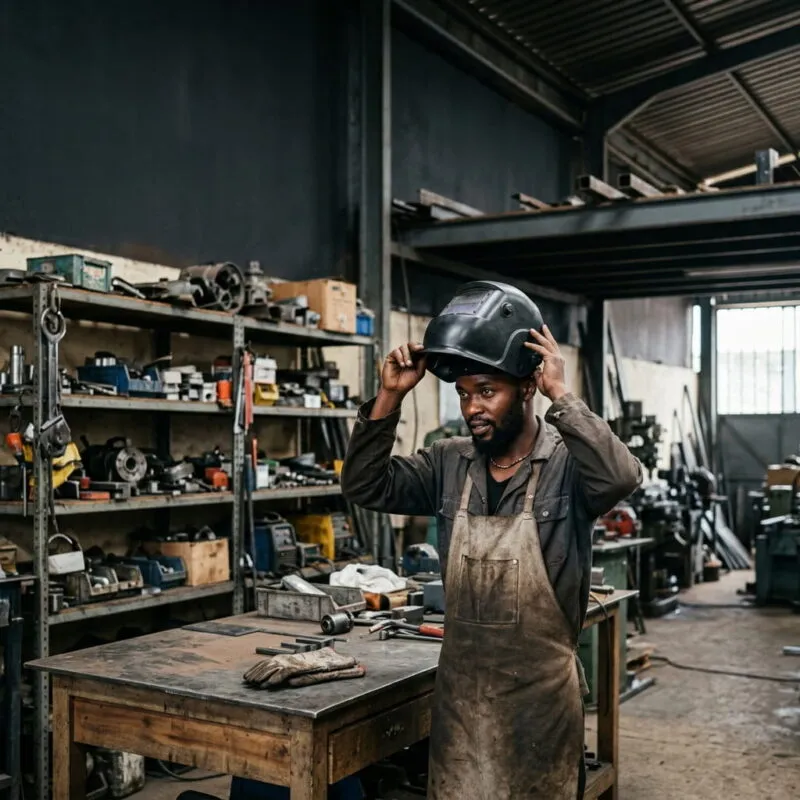
In short: our auto-darkening helmet switches automatically from a light shade 4 to a pre-selected welding shade (in the 9–13 range) the instant its photosensors detect an arc, in 0.5 milliseconds, and switches back once the arc stops. It stays flipped down for the whole job rather than needing to be flipped up and down between welding and inspecting work. It’s solar powered, and the shell is certified to BS EN 175:1997 for eye and face protection.

What “auto-darkening” actually means
Our Welding Helmet Auto Darkening Shade 9-13 (308-5220K) uses two sets of photosensors to detect arc light. The moment an arc strikes, the lens switches from its resting shade 4 (light enough to see and position work through) to the welder’s pre-selected shade, somewhere in the 9–13 range depending on the process and current. The switch takes 0.5 milliseconds — fast enough that the eye isn’t exposed to the bright flash before the lens darkens.
Shade selection is still the welder’s job
Auto-darkening doesn’t remove the need to pick the right shade for the process and amperage — it’s selected by a side-mounted adjustment dial before starting. What auto-darkening changes is that the helmet can stay down the whole time: no more flipping up to check position, then flipping back down to strike the arc.
Solar power, not batteries
The 308-5220K is solar powered, so there’s no battery to keep charged or replace mid-job — the photosensors and darkening element draw their power from ambient light.
What the certification actually covers
The shell is certified to BS EN 175:1997 for eye and face protection, and can withstand 650°C from the end of the electrode for five seconds without burning. The electronic lenses carry their own DIN EN 169 filter certification for the shade levels involved. This is suitable for Arc, MIG/MAG, TIG and Plasma welding, with permanent UV/IR protection up to DIN 15 while in use.
Is it worth the extra cost?
For occasional, single-process welding, a standard flip-front helmet (covered in our welding helmet types guide) does the job for less. The auto-darkening helmet earns its cost back in jobs with frequent starts and stops, tacking, or switching between processes — anywhere the flip-up/flip-down cycle of a standard helmet slows the work down or gets skipped under time pressure.
Frequently asked questions
How does an auto-darkening welding helmet know when to darken?
Two sets of photosensors detect arc light and trigger the lens to switch from its resting shade 4 to the pre-selected welding shade, in 0.5 milliseconds.
Do I still need to choose a shade level manually?
Yes — the welding shade (9–13 range) is set on a side-mounted adjustment dial before starting. Auto-darkening controls when the lens switches, not what shade it switches to.
Does the auto-darkening helmet need a battery?
No — it’s solar powered, drawing power from ambient light rather than a battery.
What standard is the helmet shell certified to?
BS EN 175:1997 for eye and face protection, and it’s rated to withstand 650°C from the end of the electrode for five seconds without burning.
See our overview of all four welding helmet types, our guide to welding glass shade numbers, and our closing guide to leather welding hoods and welding curtains.
Browse our full welding helmet range in stock now, or get in touch to talk through which one fits your workload.









Recent Comments