


Unlike Kenya’s fire safety rules, which set out specific numbered requirements — a 30-metre hose reel radius, a 12-month inspection cycle — the law on fall protection PPE is more general. That doesn’t mean it’s silent. It means the legal duty and the technical standard your equipment has to meet come from two different places.
In short: Section 101(1) of the Occupational Safety and Health Act, 2007 requires every employer to provide and maintain adequate, effective and suitable protective clothing and appliances for employees exposed to injurious conditions at work. It’s a general duty — it doesn’t specify harness types, D-ring configurations or inspection intervals. Those technical details come from the EN standards printed on the equipment itself (EN 361, EN 358, EN 813, EN 354, EN 355 and others), which is why matching equipment to task by standard, not just by appearance, is what actually satisfies the intent of the law.
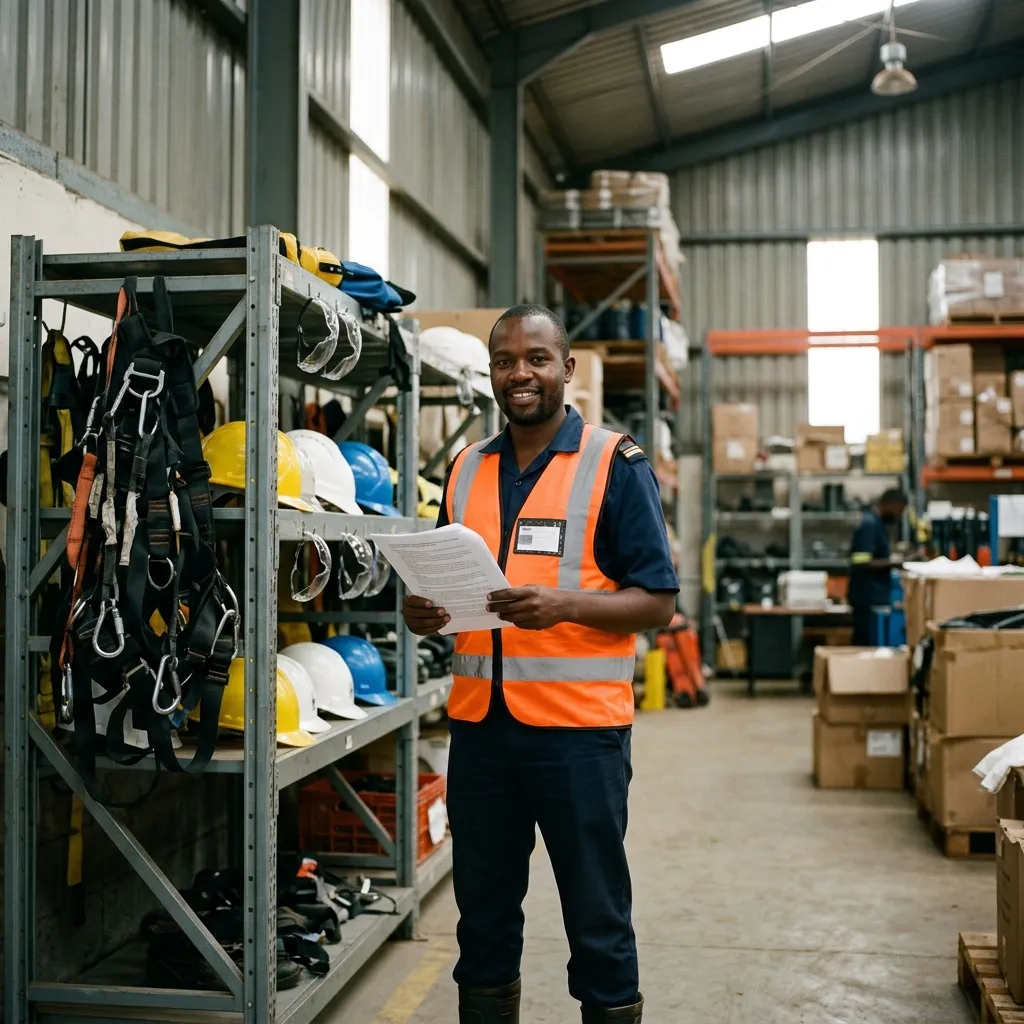
What Section 101(1) actually says
The Act’s exact wording: “Every employer shall provide and maintain for the use of employees in any workplace where employees are employed in any process involving exposure to wet or to any injurious or offensive substance, adequate, effective and suitable protective clothing and appliances, including, where necessary, suitable gloves, footwear, goggles and head coverings.” Fall protection equipment — harnesses, lanyards, rope access gear — falls within “protective appliances” for work that exposes a worker to a fall hazard, even though the section doesn’t name harnesses specifically.
Why the general/specific split matters in practice
Because Kenyan law doesn’t publish its own numbered specification for harnesses the way it does for, say, fire hose reel coverage, “suitable” in practice means equipment that meets the relevant international EN standard for the task: EN 361 for fall arrest, EN 358 for work positioning, EN 813 for rope access, EN 354 for restraint lanyards, EN 355 for fall arrest lanyards. Buying to these standards — and matching the standard to the actual task, as covered in our harness and lanyard guides — is the practical way an employer meets the general duty in Section 101(1).
Safe access is a separate general duty
The Act also places a general duty on occupiers to provide and maintain safe means of access to any place where an employee has to work, and to keep that place safe. Read together with Section 101(1), the two duties cover both the access route to a height-work location and the protective equipment used once there — but neither sets a specific numeric threshold the way the fire safety rules do.
What this means for a buying decision
If you’re equipping a team for work at height, the honest legal answer is: the Act requires you to provide suitable protective equipment, and “suitable” is defined by matching the EN standard to the actual task — not by a Kenya-specific harness specification, because one doesn’t exist in the primary Act. Our harness, lanyard and rope access guides are built around exactly that matching exercise.
Frequently asked questions
Does Kenyan law specify what type of harness to use?
No — the Occupational Safety and Health Act, 2007 places a general duty on employers to provide suitable protective appliances (Section 101(1)), but doesn’t specify harness types or configurations. Those come from international EN standards.
What does Section 101(1) of the OSH Act actually require?
It requires every employer to provide and maintain adequate, effective and suitable protective clothing and appliances for employees exposed to injurious conditions at work.
If the law doesn’t set specific harness requirements, how do I know what’s compliant?
In practice, matching your equipment to the relevant EN standard for the task (EN 361 for fall arrest, EN 358 for work positioning, EN 813 for rope access, and so on) is what satisfies the general “suitable equipment” duty.
Is there a separate legal duty for safe access to height-work locations?
Yes — occupiers have a general duty to provide and maintain safe means of access to any place employees have to work, separate from the duty to provide protective equipment itself.
See our guides to harness types by EN standard and fall arrest vs restraint lanyards to match equipment to your task.
Browse our full fall protection range in stock now, or get in touch to talk through what your team needs.







Recent Comments